Travelling to Thailand with Anxiety Disorder: Medications, Healthcare and Emergency Protocols
Thailand's controlled-substance rules affect common anxiety medications. Know the import rules, pharmacy access, and emergency steps before you fly.
Travelling to Thailand with anxiety disorder: the essentials
Thailand classifies many common anxiety medications as controlled psychotropic substances under the Psychotropic Substances Act B.E. 2518, which means import rules, documentation requirements, and pharmacy access differ significantly from what you may be used to. [5][1]
Bangkok's climate adds another layer of complexity to dealing with anxiety in Thailand: temperatures regularly exceed 33°C with humidity above 75%, a combination that can intensify physical symptoms and disrupt sleep. [8]
On a positive note, Thailand's private hospital network is strong, particularly in Bangkok and Chiang Mai, but foreign prescriptions are not accepted at local pharmacies, so treatment continuity requires advance planning[1].
This guide covers the Thai FDA's controlled-substance import rules for anxiety medications, which brand names are available locally, how to access a psychiatrist in Thailand, and what to do in an emergency[6].
Storing your International Patient Summary (IPS) on Nomedic gives Thai clinicians instant access to your diagnosis, medications, and allergy history without requiring verbal explanation.
Medical disclaimer: This guide is for informational purposes only and does not constitute medical advice. Always consult your specialist before travelling, particularly regarding changes to your treatment schedule, vaccination requirements, and travel insurance.
Key risks for anxiety disorder travellers in Thailand
Controlled-substance classification of common anxiety medications
Benzodiazepines including alprazolam, diazepam, lorazepam, and clonazepam are classified as Schedule II or IV psychotropic substances in Thailand, requiring a physician certificate to import up to a 30-day supply. Check your specific medication against the Thai FDA psychotropic list before travel.[1]
Heat and humidity amplifying physical symptoms
Bangkok's average daytime temperatures stay above 32°C year-round with relative humidity between 66% and 79%, conditions that can produce physical sensations closely resembling anxiety symptoms. See the In Country tab for detailed day-to-day management strategies.
Foreign prescriptions not accepted at Thai pharmacies
Thai pharmacies do not dispense controlled anxiety medications against foreign prescriptions. If you run out of a benzodiazepine or other scheduled medication mid-trip, you must consult a licensed Thai physician to obtain a local prescription before any pharmacy can dispense it.[2]
Customs delays for inadequately documented medications
Even with correct paperwork, travellers carrying controlled psychotropic medications have reported extended inspection at Thai customs if physician letters lack the prescriber's licence number or do not match the format expected by officers. Be sure to carry all documents in a clear folder that's immediately accessible in your hand luggage.[3]
Insurance exclusions for pre-existing mental health conditions
Standard travel insurance policies frequently exclude pre-existing mental health conditions unless explicitly declared and underwritten. A psychiatric emergency in a Bangkok private hospital without cover can generate significant out-of-pocket costs.
Jet lag and travel disruption destabilising routine
Thailand spans a single time zone (UTC+7) with no daylight saving, but long-haul flights from many departure regions involve significant time differences that disrupt sleep and medication timing. Plan your dosing schedule adjustment with your prescriber before departure.
Preparation checklist
- Check your medications against the Thai FDA psychotropic list – Verify each medication's schedule classification at permitfortraveler.fda.moph.go.th at least four weeks before departure.
- Obtain a physician certificate for controlled medications – Your doctor's letter must include your name, diagnosis, medication name, dosage, quantity, and the prescriber's name, address, and licence number.
- Apply for Form IC-2 if required – If any of your medications fall under Schedule II psychotropics or narcotics, apply online to the Thai FDA at least 15 days before travel; processing typically takes 7 to 14 business days.
- Book a pre-travel appointment with your psychiatrist – Discuss time-zone adjustment for your dosing schedule, heat management, and a contingency plan if symptoms escalate.
- Arrange travel insurance that explicitly covers anxiety disorder – Declare your condition, subtype, current medications, and last episode date at application.
- Build your Nomedic IPS – Store your anxiety disorder diagnosis, all medications with INNs, allergies, and emergency contacts so any clinician worldwide can access your full clinical picture instantly.
- Pack a 30-day supply maximum for scheduled medications – Bring medication in original, labelled packaging; do not repackage or combine into pill organisers for controlled substances.
- Carry all documentation in an accessible folder in hand luggage – Physician certificate, prescriptions, Thai FDA permit (if applicable), and a copy of your Nomedic IPS QR code.
- Identify a psychiatrist near your destination before you travel – Search for English-speaking psychiatrists at private hospitals in Bangkok, Chiang Mai, or your destination city and save contact details offline.
- Save Thai emergency numbers offline — Ambulance: 1669, Police: 191. Store these in your Nomedic profile alongside your insurer's 24-hour assistance line.
Documents to carry when travelling to Thailand with anxiety disorder
Thai customs officers and hospital staff may request documentation for controlled anxiety medications at entry or at the point of care. Keep the following accessible on your phone via the Nomedic app and in physical copies in your hand luggage.
Your International Patient Summary (IPS)
Your Nomedic IPS contains your anxiety disorder diagnosis, current medications with INNs and doses, known allergies, and emergency contacts in a format readable by any clinician worldwide. In Thailand, where verbal communication can be challenging in an emergency, showing your IPS QR code at triage means clinicians can access your full clinical picture in seconds without needing you to explain your history.
The IPS is stored offline in the Nomedic app and can be shared via QR code or exported as a PDF. Thai hospital staff, particularly at international hospitals in Bangkok and Chiang Mai, are familiar with structured patient summaries and can act on them immediately.
Full document checklist
Keep the following accessible on your phone and ready to share. Your Nomedic IPS covers items 1 and 6 automatically.
- ·Your Nomedic IPS Covers your anxiety disorder diagnosis, current medications, allergies, and functional status. Accessible offline with a shareable QR code.
- ·Physician certificate for controlled medications Must state your name, diagnosis, each medication's INN and brand name, prescribed dose, total quantity, and your prescriber's full name, address, and licence number.[1]
- ·Original prescriptions with INN names Thai authorities verify medications by INN, not brand name; ensure all prescriptions list the generic name clearly.[2]
- ·Thai FDA Form IC-2 permit (if applicable) Required if any of your medications fall under narcotics Schedule II or III; must be obtained at least 15 days before arrival.[3]
- ·Travel insurance schedule Policy number and insurer's 24-hour line saved in your Nomedic profile.
- ·Thai emergency numbers Ambulance: 1669. Police: 191. Fire: 199.[4] Saved offline in your Nomedic profile.
Bringing your anxiety disorder medications to Thailand
Thailand permits travellers under medical treatment to bring psychotropic substances in Schedule II, III, and IV for personal use, provided the quantity does not exceed a 30-day supply and is accompanied by a physician certificate from the prescribing doctor. For quantities between 31 and 90 days, a Form IC-2 permit from the Thai FDA is required and must be applied for online at least 15 days before arrival.[1]
All medications must be kept in their original, clearly-labelled prescription packaging throughout your stay in Thailand. Verify your specific medication's schedule classification using the Thai FDA's online permit checker before you travel.[1]
Do not post your medication to Thailand.
Under Section 12 of Thailand's Drugs Act B.E. 2510, importing medications by post or courier is not permitted for travellers. Always carry your medications in person in your hand luggage, never in checked baggage or shipped ahead.
Anxiety disorder medications: brand names, INNs, and availability in Thailand
The following table lists commonly prescribed anxiety disorder medications, their INNs, the brand names used in Thailand, and any travel-relevant storage or interaction notes.
Schedule II psychotropic in Thailand. Requires physician certificate for up to 30-day supply. Store at room temperature; do not exceed 30°C.
Schedule IV psychotropic in Thailand. Requires physician certificate. Do not combine with alcohol.
Schedule IV psychotropic in Thailand. Requires physician certificate and local prescription for any refill.
Schedule IV psychotropic in Thailand. Physician certificate required. Controlled availability at hospital pharmacies.
Not a controlled substance in Thailand. No permit required; physician letter recommended.
Escitalopram and buspirone: avoid concurrent use with MAOIs
Both escitalopram and buspirone carry contraindications with monoamine oxidase inhibitors (MAOIs). If a Thai doctor prescribes anything new during your trip, show your full medication list from your Nomedic IPS before accepting any new prescription. The risk of serotonin syndrome increases if an MAOI is added to an existing SSRI or buspirone regimen. Do not start or stop any medication without consulting your treating clinician.
Travelling with anxiety medications that require specific storage
Most oral anxiety medications do not require refrigeration, but Thailand's heat and humidity mean storage temperatures can exceed recommended limits if medications are left in checked luggage, car boots, or in direct sun. These steps apply regardless of which region of Thailand you're visiting.
Your medication list, ready to share.
Nomedic stores your medication name, INN, dosage, and frequency – readable by any clinician worldwide.
Healthcare and prescriptions in Thailand
Thailand operates a national public health system under the Ministry of Public Health, but foreign visitors without a work permit or long-term visa do not qualify for subsidised public hospital care and are treated as private patients – at both private and public facilities.
There is no reciprocal healthcare agreement between Thailand and any EU, EEA, or most other countries, meaning all consultation and treatment costs are payable directly.
Psychiatrist consultations at private hospitals in Bangkok typically cost between 2,500 and 5,000 THB (77 and 155 USD) per appointment, with specialist mental health clinics starting from around 1,500 THB (46 USD). [6]
Foreign prescriptions are not accepted at Thai pharmacies for controlled substances; you must see a Thai-registered doctor to obtain a local prescription.[6]
Saying that, SSRIs such as fluoxetine, sertraline, and escitalopram are widely available at larger Thai pharmacies and are often dispensed without a prescription, though carrying your own supply and documentation remains the safest approach.
Benzodiazepines, including alprazolam, diazepam, and lorazepam, are classified as controlled psychotropic substances and legally require a valid prescription from a Thai-registered physician before any pharmacy can dispense them. Buspirone is not classified as a controlled substance in Thailand and is more straightforwardly available.[5]
Controlled anxiety medications are dispensed through different channels
Benzodiazepines and other scheduled psychotropics cannot be obtained over the counter in Thailand. If you need an emergency supply, go directly to the psychiatry outpatient department (แผนกจิตเวช, phaenaek chitwaet) at a private hospital such as Bumrungrad International, Samitivej, or Bangkok Hospital. Bring your Nomedic IPS and your physician certificate from home; the Thai doctor will assess you and, if clinically appropriate, issue a local prescription that a hospital pharmacy can fill.
Thailand: finding an anxiety disorder specialist
Psychiatrists (จิตแพทย์, chitphaet) practise at the psychiatry clinics of major private hospitals across Bangkok and Chiang Mai, including Bumrungrad International Hospital, Samitivej Sukhumvit, and Bangkok Hospital. Many psychiatrists at these facilities have trained internationally and conduct consultations in English. [7]
Walk-in appointments are possible at some private hospital psychiatry departments, but booking in advance is strongly recommended to reduce waiting times, which can otherwise extend to several hours in a busy outpatient setting. Identify and save the address and phone number of the nearest psychiatry clinic before your trip.[7]
Search for providers near your destination
Use Nomedic's provider search to find anxiety disorder specialists in Thailand. Save the address and phone number offline before you travel.
If you run out of or lose your anxiety medication in Thailand
Losing an SSRI for a day or two is unlikely to cause acute harm for most people, but abruptly stopping a benzodiazepine carries a different risk profile, and you should not attempt to manage a controlled-medication supply failure without medical guidance. Try to contact your home prescriber by phone or telemedicine as soon as the problem arises to confirm the best course of action before seeking a local replacement.
Managing day-to-day humidity, heat, and sensory overload in Thailand
Bangkok's average daytime temperature stays above 32°C year-round with relative humidity consistently above 66%, peaking at 79% during the June to September monsoon season. Heat-driven physical sensations including a racing heart, breathlessness, and sweating closely overlap with common anxiety symptoms and can be difficult to distinguish in the moment.[8]
If you're travelling to Thailand and living with anxiety disorder, try to structure your days around Thai rhythm: plan any demanding activities or outdoor sightseeing before 10 am or after 5 pm when heat intensity reduces.
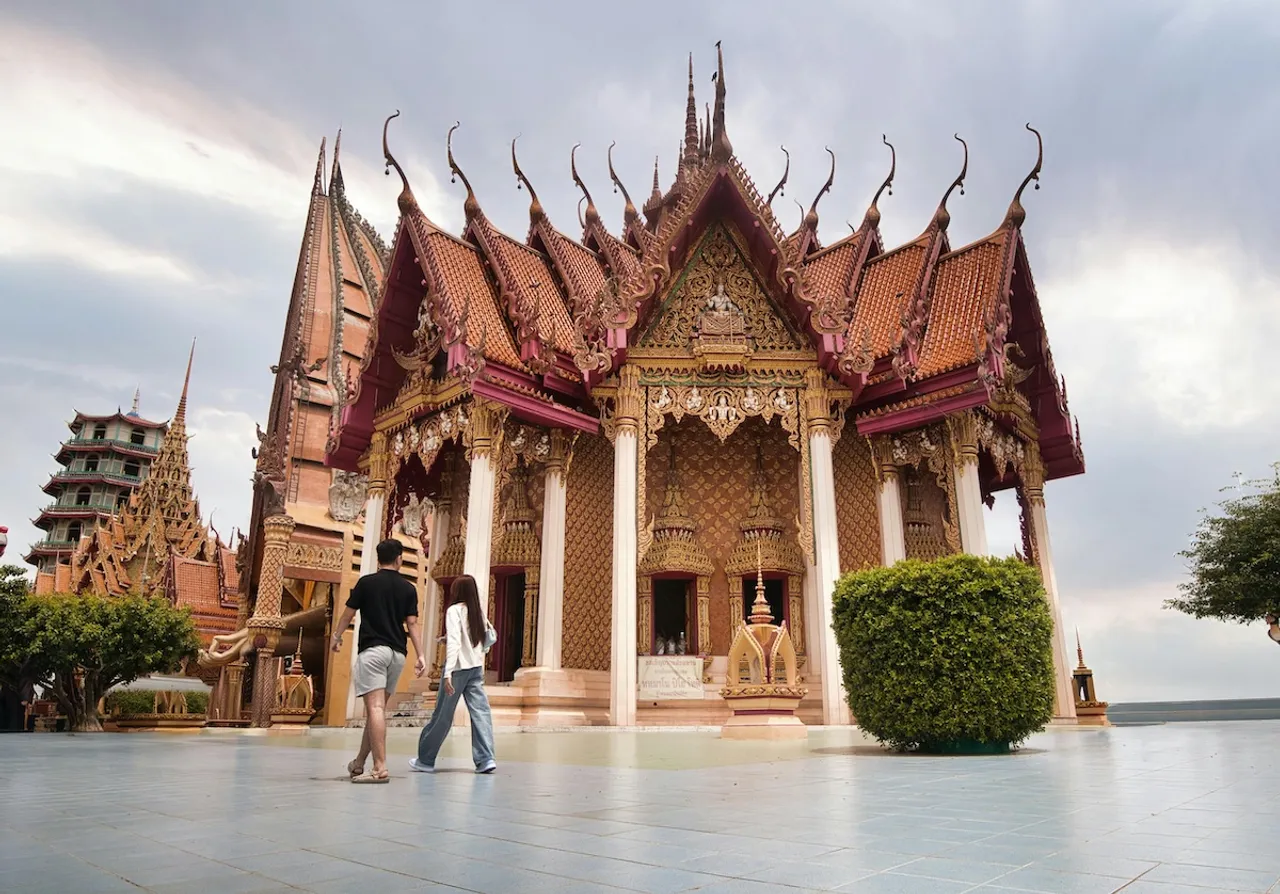
Thailand's temples, shopping centres, and BTS Skytrain stations are heavily air-conditioned so offer reliable cooling refuges throughout the day. Carry a reusable water bottle and take sips consistently, as dehydration compounds both heat stress and anxiety.
If jet lag is disrupting sleep, prioritise stabilising your sleep schedule in the first two days before exploring, since sleep deprivation is a significant trigger for anxiety episodes. Bangkok has a large network of English-speaking pharmacies where you can purchase oral rehydration salts and antihistamines without a prescription if needed.
Heat symptoms are not always an anxiety episode
Experiencing palpitations, dizziness, and breathlessness in Thailand is frequently heat-related rather than anxiety-driven, though it can be hard to pinpoint. Move to a cool, shaded space, drink water, and rest for 15 to 20 minutes. If symptoms resolve after cooling down, a heat response is the likely cause. If symptoms persist beyond 30 minutes or are accompanied by chest pain, fainting, or confusion, follow the guidance in the Emergency tab immediately.
Thai phrases for clinicians
Show your Nomedic IPS first – it removes the need to explain your diagnosis verbally. If verbal communication is needed:
“ฉันเป็นโรควิตกกังวล”
I have anxiety disorder.
“ฉันกำลังมีอาการวิตกกังวลรุนแรง”
I am having a severe anxiety episode.
“ฉันต้องการพบจิตแพทย์”
I need to see a psychiatrist.
“ฉันกินยาสำหรับโรควิตกกังวล”
I take medication for anxiety disorder.
“แผนกจิตเวชอยู่ที่ไหน”
Where is the psychiatry department?
“ฉันต้องการยาฉุกเฉินสำหรับโรควิตกกังวล”
I need an emergency supply of my anxiety medication.
Insurance considerations
What to know about travel insurance
Many insurers treat anxiety disorder as a pre-existing condition subject to exclusion or additional premium loading, and incomplete disclosure at application can void your entire policy. Psychiatric consultations at private hospitals in Bangkok typically cost between 2,500 and 5,000 THB (77 and 155 USD) per appointment, and a hospital admission for a mental health crisis can run substantially higher without cover.
What to look for in a policy
Not just 'pre-existing conditions covered'. Your condition should be named on the schedule of benefits.
Covers repatriation to your home country if local psychiatric care is insufficient or unavailable in your area of Thailand.
Covers emergency replacement if your controlled-substance medication is lost, damaged, confiscated, or delayed.
So someone can communicate with Thai clinicians on your behalf in Thai if needed.
What to declare at application
Declare thoroughly. Incomplete disclosure can invalidate your entire policy, not just the anxiety disorder-related claim.
Specify whether your diagnosis is generalised anxiety disorder, panic disorder, social anxiety disorder, or another subtype, as underwriters assess these differently.
Use the INN alongside the brand name. Include any benzodiazepines, SSRIs, SNRIs, or buspirone you take regularly or as needed.
Include whether any previous episode required hospitalisation, emergency attendance, or changes to medication.
Declare any comorbidities commonly associated with anxiety disorder, including depression, insomnia, or hypertension, as these affect underwriting decisions.
Your policy number and emergency assistance line, saved alongside your IPS and accessible offline.
Thailand has no reciprocal healthcare agreement with EU or EEA countries, so an EHIC or GHIC card provides no entitlement to state-funded care in Thailand. All treatment costs are payable directly, making comprehensive private travel insurance essential regardless of your card status. Do not rely on your card as a substitute for insurance when travelling to Thailand.
Emergency protocol
Attending a hospital emergency department in Thailand
A severe anxiety episode that does not resolve with your usual coping strategies, or that is accompanied by chest pain, fainting, or prolonged dissociation, warrants emergency assessment. Call your travel insurer's 24-hour assistance line first if your condition permits, as they can direct you to the most appropriate facility and arrange direct billing. In Bangkok, the emergency departments at Bumrungrad International Hospital and Samitivej Sukhumvit are equipped to manage psychiatric emergencies with English-speaking staff.
When you arrive – follow in order
Full clinical picture in seconds, no verbal explanation needed.
Hand your phone to the triage nurse:
ฉันเป็นโรควิตกกังวลและกำลังมีอาการรุนแรง
I have anxiety disorder and I am experiencing a severe episode.
Thai clinicians need to know your current medications, including any benzodiazepines, before administering anything new.
Ask the clinician to review your full medication list from your Nomedic IPS before any prescription is issued, particularly if you take SSRIs or buspirone.
Calls and location
Emergency ambulance in Thailand: call 1669. Police: 191. If you are in a tourist area, hotel staff or tourist police (1155) can assist with translation and directing emergency services. Give your location by naming the nearest landmark, hotel, or BTS Skytrain station rather than a street address, as Bangkok addresses can be difficult for dispatchers to process quickly.
In hospital
If you take benzodiazepines, inform the treating clinician and anaesthetist before any sedative, pain relief, or procedural medication is administered, as combination with other central nervous system depressants significantly increases sedation and respiratory risk. Your Nomedic IPS lists your medication; point to it immediately on arrival.
After any emergency
Before you leave the hospital if possible, particularly if your anxiety medications were adjusted or new ones prescribed during treatment.
Required for insurer reimbursement and continuity of care with your home specialist.
Open Nomedic and tap Share to generate a QR code any clinician can scan.
Frequently asked questions
Is anxiety medication legal in Thailand?
Yes, anxiety medications are legal to bring into Thailand, provided they are accompanied by a physician certificate from your prescribing doctor and the quantity does not exceed a 30-day supply. For supplies of 31 to 90 days, you must also obtain a Thai FDA Form IC-2 import permit, applied for online at least 15 days before arrival.
Can I bring my anxiety disorder medication into Thailand?
Yes, provided you carry no more than a 30-day supply and have a physician certificate stating your name, diagnosis, medication name and INN, dose, total quantity, and your prescriber's name, address, and licence number. Benzodiazepines such as alprazolam, diazepam, and lorazepam are Schedule II or IV psychotropic substances in Thailand; SSRIs such as escitalopram and sertraline are generally not controlled and require only a physician letter.
Do not post medication to Thailand
Importing medications by post or courier is prohibited under Thai law regardless of the drug's classification.
Are anxiety disorder medications available in Thailand pharmacies?
SSRIs including escitalopram (Lexapro) and sertraline (Zoloft) are widely available at larger pharmacies in Bangkok and Chiang Mai, sometimes without a prescription, though carrying your own supply is strongly recommended. Benzodiazepines including alprazolam (Xanax), diazepam (Valium), and lorazepam (Ativan) are classified as controlled psychotropic substances and require a prescription from a Thai-registered physician; the best route for emergency supply is via the psychiatry outpatient department (แผนกจิตเวช) at a private hospital.
What are the emergency numbers in Thailand?
Ambulance
1669
Police
191
Tourist Police
1155 (English-speaking, available 24 hours)
Fire
199
How can I communicate my anxiety disorder diagnosis in an emergency in Thailand?
Show your Nomedic IPS first. If verbal communication is needed:
“ฉันเป็นโรควิตกกังวล”
I have anxiety disorder.
“ฉันกินยาสำหรับโรควิตกกังวล”
I take medication for anxiety disorder.
Can Thailand's heat trigger anxiety symptoms, and how do I manage it?
Bangkok's year-round temperatures above 32°C with humidity regularly exceeding 75% can produce palpitations, breathlessness, and dizziness that closely mimic anxiety symptoms. The practical response is the same in both cases: move to a cool, air-conditioned environment, hydrate, and rest. Structure outdoor activities for the cooler early morning or late afternoon hours, and use Bangkok's extensive air-conditioned BTS Skytrain and MRT network to move between locations during the hottest part of the day.
Distinguish heat from anxiety
If symptoms resolve within 20 to 30 minutes of moving to a cool environment and drinking water, a heat response is the most likely cause. Symptoms persisting beyond 30 minutes or accompanied by chest pain or confusion require emergency assessment.
Do I need special travel insurance to visit Thailand with anxiety disorder?
Standard travel insurance policies frequently exclude anxiety disorder as a pre-existing mental health condition, and Thailand has no reciprocal healthcare agreement with most countries, meaning all private hospital costs are payable directly. Psychiatrist consultations at private Bangkok hospitals typically cost 2,500 to 5,000 THB (77 and 155 USD), and a hospital admission without cover can cost substantially more. You need a policy that explicitly names anxiety disorder as covered.
Declare thoroughly
Declare your subtype, current medication, last episode date, and any associated conditions at application. Incomplete disclosure invalidates the entire policy, not just the anxiety disorder-related claim.
Sources
- [1] Thai FDA – Guidance for Travellers Carrying Personal Medications (Version 5, September 2024)
- [2] Thai FDA – Importation Guidelines for Personal Use (Official Thai FDA Website)
- [3] Thai FDA – Medication Import Permit for Travellers (Online Portal)
- [4] Royal Thai Embassy Stockholm – Restricted Medicine Guidance
- [5] INCB – Thailand Traveller Information on Controlled Substances (2024)
- [6] Thai Ministry of Public Health – Food and Drug Administration
- [7] Samitivej Hospitals Bangkok – Psychiatry Clinic
- [8] Weather Atlas – Bangkok Climate and Monthly Weather
- [9] US FDA – Escitalopram Prescribing Information (OpenFDA)
- [10] US FDA – Buspirone Hydrochloride Prescribing Information (OpenFDA)
- [11] WHO – Mental Health Gap Action Programme (mhGAP)
More guides in Thailand
- CityChiang Mai Health Guide
- CityBangkok Health Guide
- CityPhuket Health Guide
- ConditionDiabetes in Thailand: Insulin Storage, Import Rules and Heat Management
- ConditionTransgender in Thailand: HRT Import Rules, Clinics and Hormone Access
- ConditionTravelling to Thailand with ADHD: Medications, Customs Rules and Healthcare
- ConditionPregnancy in Thailand: Hospitals, Costs & Mosquito Risk
- MedicationAtomoxetine in Thailand: Strattera, Import Rules, and Pharmacy Access
- MedicationBenzodiazepines in Thailand: Controls, Brands and Pharmacy Access
- MedicationAdderall in Thailand: Category 1 Narcotic Ban, ADHD Plan
- MedicationAmphetamine / Dextroamphetamine in Thailand: Category 1 Ban and Legal Risk
- MedicationBuspirone in Thailand: Import Rules, Brands and Pharmacy Access
- MedicationConcerta in Thailand: Category 2 Status, Supply and Prescribers
- MedicationDexamfetamine in Thailand: Controls and Import Rules
- MedicationDiazepam in Thailand: Controls, Import Rules and Brands
- MedicationGuanfacine in Thailand: Import Rules, Brands and Prescribing
- MedicationInsulin in Thailand: Import Rules, Brands and Cold Chain
- MedicationLorazepam in Thailand: Controls, Import Rules and Pharmacy Access
- MedicationMedikinet in Thailand: Supply, Controls and Sibling Brands
- MedicationMelatonin in Thailand: Import Rules, Brands and Pharmacy Access
- MedicationMethylphenidate in Thailand: Category 2 Rules, Brands and Permits
- MedicationRitalin in Thailand: Hospital-Only Access, IR vs Concerta
- MedicationSemaglutide in Thailand: Import Rules, Heat Storage and Brands
- MedicationVyvanse (Lisdexamfetamine) in Thailand: Category 1 Ban, Legal Risk and Alternatives
- MedicationXanax in Thailand: Legal Status, Supply and Prescribers