
Travelling to Italy in a Wheelchair: Healthcare, Medications and Emergency Protocols
Italy's cobblestones, heat, and healthcare rules create specific challenges for wheelchair users. Here's what to prepare before you travel.
Wheelchair travel in Italy: what you need to know
Italy's historic cities present genuine accessibility barriers: cobblestone streets across central Rome, Venice's bridges, and older buildings with retrofitted access that does not always work as advertised.
At the same time, Italian law requires rail stations, airports, hotels, and most restaurants to meet wheelchair accessibility standards. The Sala Blu – a specialized service from Rete Ferroviaria Italiana (RFI) that provides assistance for travellers with disabilities or reduced mobility – covers over 250 stations.[2]
This guide to wheelchair travel in Italy covers what to carry, how to bring your medications into the country within the 30-day import limit, how to find a rehabilitation or physiatry specialist if needed, and what to say in Italian in an emergency. Your Nomedic International Patient Summary (IPS) removes the need to explain your functional status from scratch at every clinic.
Medical disclaimer: This guide is for informational purposes only and does not constitute medical advice. Always consult your specialist before travelling, particularly regarding changes to your treatment schedule, vaccination requirements, and travel insurance.
Key risks for wheelchair travellers in Italy
Cobblestone terrain and uneven pavements
Central Rome, parts of Florence, and much of Venice involve cobblestones, stepped bridges, or streets without dropped kerbs that can make manual wheelchair use difficult or painful. Research your specific route using Google Street View before arrival and book accommodation close to your target attractions to minimise outdoor transit.[2]
Summer heat and pressure injury risk
Italy's summer temperatures can exceed 40°C in Rome and 48°C in Sicily, and the Italian Health Ministry has previously issued red-level heat alerts for up to 27 cities simultaneously. Sustained heat in combination with prolonged sitting increases pressure injury risk; see the environmental management section for day-to-day strategies.[7]
Inaccessible accommodation
Many Italian hotels advertise wheelchair access but have steps before the lift or bathrooms that are not genuinely roll-in accessible. Contact hotels directly and request photos of the entrance, the lift dimensions, and the bathroom before booking[2].
Medication import limit
The Italian Ministry of Health limits personal medication imports to a 30-day supply for prescription drugs, and controlled substances require a certificate from your home health authority[1]. If your trip extends beyond 30 days, consult your specialist and the Italian Ministry of Health before departure.
Transport and transfer gaps
Accessible taxis and adapted vans are limited in most Italian cities. Book wheelchair-accessible transfers well in advance[3]. For trains, contact Trenitalia's Sala Blu network (199 30 30 60) at least 24 hours before departure to arrange boarding assistance.
Preparation checklist
- Confirm your 30-day medication supply – The Italian Ministry of Health limits personal prescription imports to 30 days; pack accordingly and request a full specialist letter.
- Obtain a controlled substance certificate if needed – If you carry any narcotic or psychotropic medication, obtain a certificate endorsed by your home health authority before departure; Italy requires this at the border.
- Book Sala Blu rail assistance – Contact Trenitalia's Sala Blu (199 30 30 60) at least 24 hours before each train journey to arrange boarding and alighting assistance.
- Verify your hotel's accessibility in writing – Ask for photos of the entrance, lift dimensions, and bathroom; do not rely on self-reported accessibility ratings.
- Book accessible airport transfers in advance – Wheelchair-accessible taxis and adapted vans are scarce; pre-book from your destination city before you travel.
- Create your IPS on Nomedic – Your International Patient Summary should include your diagnosis, functional status, all medications with INNs, and allergy information; save it offline.
- Pack pressure relief equipment – Include your usual cushion, positioning aids, and any skin inspection tools; Italian pharmacies stock basic wound care but not specialist seating.
- Carry medications in original packaging – Keep all prescription drugs in their labelled original containers with a copy of your prescription and a specialist letter.
- Check for accessible tour options – For Vatican, Pompeii, and other major sites, book an accessible guided tour in advance as the standard group tour route is often inaccessible.
- Save emergency numbers offline – Ambulance: 118, Police: 113, Pan-European: 112; store these in Nomedic before you lose connectivity.
Documents to carry when travelling to Italy in a wheelchair
Italian clinicians and customs officials need to understand your diagnosis, functional status, and medication list quickly. The Nomedic app stores everything in one place, readable offline, and shareable via QR code.
Your International Patient Summary (IPS)
Your Nomedic IPS is structured to the HL7 FHIR IPS standard, which Italian hospitals can read directly. It contains your diagnosis, functional status, current medications with INNs, allergies, and emergency contacts in a format any clinician can act on without translation.
In an emergency department (pronto soccorso), showing your IPS immediately saves critical time. It also satisfies Italian customs requirements for documentation when carrying prescription medications across the border.
Full document checklist
Keep the following accessible on your phone and ready to share. Your Nomedic IPS covers items 1 and 6 automatically.
- ·Your Nomedic IPS Covers your diagnosis, functional status, medications, allergies, and emergency contacts. Offline and QR-accessible.
- ·Specialist letter Must state your diagnosis, wheelchair classification, current medications with INN names and doses, and the clinical necessity for each.[1]
- ·Prescriptions with INN names Carry originals or certified copies with your name, the INN, brand name, dose, and prescribing physician's details.[4]
- ·EHIC or equivalent health card If you hold an EHIC, carry the physical card; it must be shown at SSN-affiliated providers to access care at Italian resident rates.[5]
- ·Travel insurance schedule Policy number and insurer's 24-hour line saved in your Nomedic profile.
- ·Italy emergency numbers Ambulance: 118, Police: 113, Fire: 115, Pan-European: 112.[2] Saved offline in Nomedic.
Bringing your medications to Italy as a wheelchair user
The Italian Ministry of Health permits foreign travellers to bring personal prescription medications for up to 30 days of their stay.[1] Carry a copy of your prescription and keep all medications in their original labelled packaging.
For controlled substances such as narcotics or psychotropic medications, you must hold a certificate issued by the health authority of your country of residence, valid for a maximum of 30 days, as required under Italy's implementation of the Schengen Agreement.[4]
Do not post your medication to Italy.
Bringing medications into Italy by mail or courier is tightly controlled by Italian Customs. All shipments, even small personal-use quantities, must be cleared by customs, delays are common, and the recipient must provide a letter from an Italian doctor confirming the medication is essential. Always carry your medications in person in your hand luggage.
Wheelchair-related medications: brand names, INNs, and Italy availability
Italian pharmacies dispense by active substance (INN); knowing your INN is essential if you need a replacement or consult a local physician. The following are common medications used by wheelchair users and their Italian brand equivalents.
Available at Italian retail pharmacies (farmacia) on prescription. Keep in original packaging.
Abrupt discontinuation may cause rebound hypertension; do not miss doses without medical advice.
Controlled substance in Italy (Class A narcotic schedule). Carry health authority certificate.
Available on SSN prescription. Confirm availability with your local ASL if planning extended stay.
Tizanidine (Sirdalud) and fluoroquinolone antibiotics
If you are prescribed a fluoroquinolone antibiotic (such as ciprofloxacin or levofloxacin) while in Italy, inform the prescribing doctor that you take tizanidine. Concurrent use significantly raises tizanidine blood levels and can cause dangerous hypotension and sedation. Ask for an alternative antibiotic class where possible.
Travelling with injectable therapies
If your treatment plan includes injectable medications, these steps apply regardless of which Italian city you are visiting.
Your medication list, ready to share.
Nomedic stores your medication name, INN, dosage, and frequency — readable by any clinician worldwide.
Healthcare and prescriptions in Italy
Italy's public health system is the Servizio Sanitario Nazionale (SSN), a universal, tax-funded service. EU/EEA travellers with a valid EHIC can access SSN-affiliated providers under the same co-payment (ticket) conditions as Italian residents; non-emergency specialist visits carry a co-payment (visita occasionale) that varies by region.[5] Travellers without EHIC must use private clinics or pay full tariffs, which typically cost approximately €150 for a physician assessment.
Foreign prescriptions are not directly accepted at Italian pharmacies; you need a prescription from a licensed Italian physician to obtain replacement medication locally. For SSN access, present your EHIC at an ASL (Azienda Sanitaria Locale) office or affiliated hospital.[6]
AIFA (Agenzia Italiana del Farmaco) classifies medications into Class A (reimbursed, dispensed on SSN prescription) and Class C (patient-paid). Most wheelchair-related maintenance medications such as baclofen and gabapentin fall under Class A when prescribed by an Italian doctor. Controlled substances including diazepam require a special prescription (ricetta ministeriale a ricalco) and are not available on a standard retail prescription.[8]
Spasticity medications are dispensed at retail pharmacies
Unlike biologics or disease-modifying therapies for other conditions, most oral spasticity medications (baclofen, tizanidine) are available at standard retail farmacie on an Italian prescription. If you run out, go to any farmacia (look for the illuminated green cross) and ask to see the duty pharmacist. Bring your Nomedic IPS and specialist letter so an Italian GP can issue a replacement prescription quickly.
Finding a rehabilitation or physiatry specialist
Rehabilitation medicine in Italy is delivered through the speciality of Medicina Fisica e Riabilitazione (physiatry). Physiatry outpatient departments (ambulatori di riabilitazione) exist within most major public hospitals and university medical centres (policlinici) across Rome, Milan, Florence, and Naples[3]. Walk-in appointments are not standard; contact the ASL or present at the pronto soccorso for urgent referral. Identify the nearest physiatry department before you travel and save the address and number offline.
Search for providers near your destination
Use Nomedic's provider search to find rehabilitation specialists in Italy. Save the address and phone number offline before you travel.
If your wheelchair or assistive device fails in Italy
Equipment failure is disruptive but usually solvable. Italy has orthopaedic and assistive technology suppliers (negozi ortopedici) in all major cities, and airline damage claims can be filed immediately on arrival.
Managing heat and pressure injury in Italy
Italian summer temperatures regularly reach 38°C to 44°C in Rome and exceed 48°C in Sicily, and Italy's Health Ministry issues red-level heat alerts across multiple cities each year. Prolonged heat exposure combined with sustained sitting significantly elevates pressure injury risk, particularly on cobblestone surfaces where vibration reduces effective pressure relief[7].
Italy's midday riposo (roughly noon to 3 pm) is a practical framework: plan demanding outdoor activity in the morning before 11 am or after 5 pm, when the Italian Health Ministry advises avoiding direct sunlight[9]. Use this midday window for pressure relief in air-conditioned spaces: Italian churches, museums, and shopping galleries (gallerie) provide free air-conditioned rest areas in most city centres.
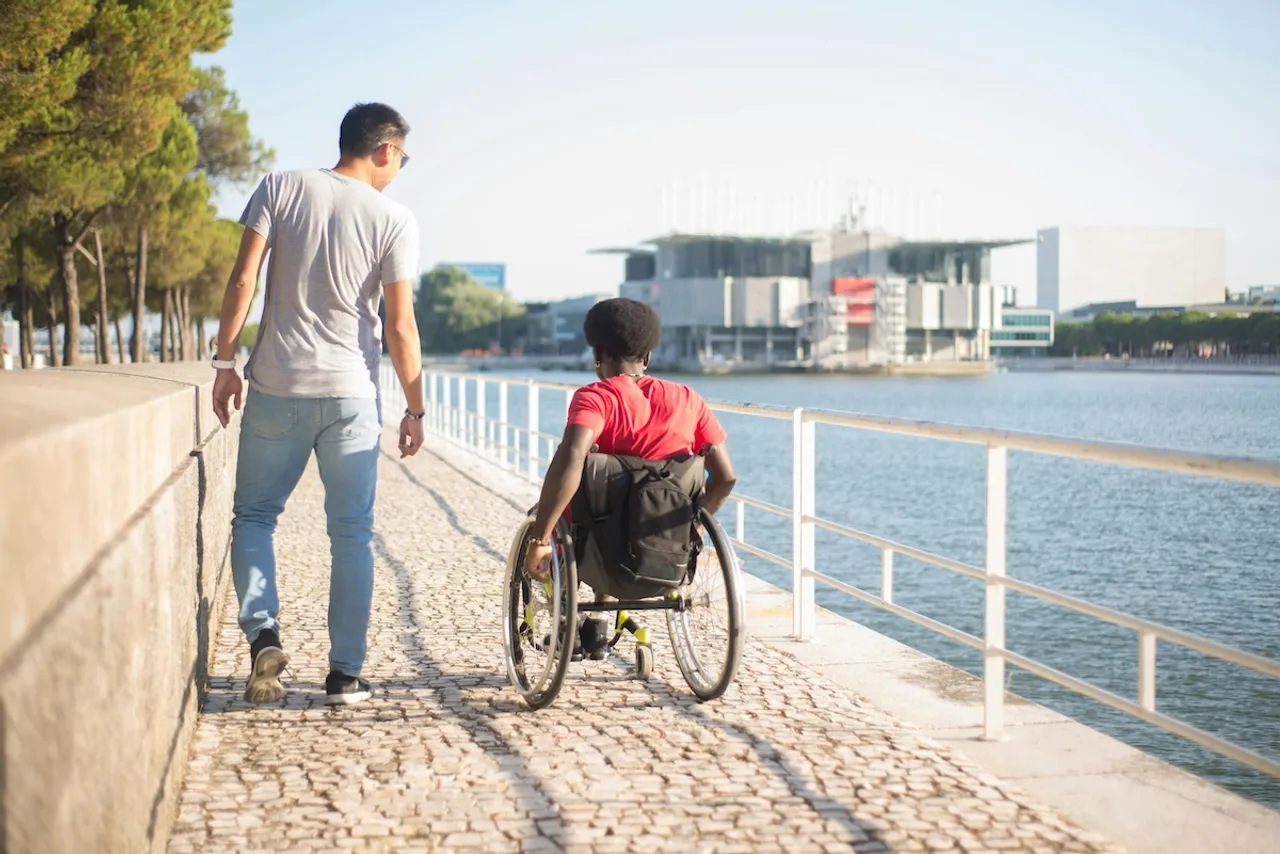
Italian pharmacies stock cooling sprays, hydration salts, and basic wound care; ask the farmacista for prodotti per la cura della pelle (skin care products) if you need supplies. Carry a portable pressure-relief cushion and schedule a full skin inspection every evening, not just when symptoms appear.
Heat-related skin changes are not the same as a pressure injury developing
Redness from heat and sweat in bony prominences will usually resolve within 30 minutes of pressure relief in a cool environment. If redness persists beyond 30 minutes after full offloading, or if there is any break in skin integrity, follow the guidance in the Emergency tab and seek clinical review at the nearest pronto soccorso or ASL clinic.
Italian phrases for clinicians
Show your Nomedic IPS first – it removes the need to explain your diagnosis verbally. If verbal communication is needed:
“Uso una sedia a rotelle e ho bisogno di assistenza medica.”
I use a wheelchair and need medical assistance.
“Ho una lesione del midollo spinale / una malattia neuromuscolare.”
I have a spinal cord injury / a neuromuscular condition.
“Ho bisogno di un medico specializzato in medicina fisica e riabilitazione.”
I need a specialist in physical medicine and rehabilitation.
“Prendo il baclofen / la tizanidina per la spasticità.”
I take baclofen / tizanidine for spasticity.
“Dov'è il reparto di riabilitazione più vicino?”
Where is the nearest rehabilitation department?
“Ho bisogno di una fornitura urgente di farmaci.”
I need an emergency supply of my medication.
Insurance considerations
What to know about travel insurance
Many standard travel policies exclude claims arising from pre-existing conditions, including those requiring wheelchair use, unless specifically declared and accepted at underwriting. Emergency hospitalisation, specialist consultations, and medical repatriation in Italy can cost several thousand euros without cover.
What to look for in a policy
Not just 'pre-existing conditions covered'. Your diagnosis and wheelchair dependency should be listed on the policy schedule.
Covers repatriation if local care is insufficient for your needs, including accessible transport.
Covers emergency repair or replacement of your wheelchair or assistive device if it is lost, damaged, or delayed by an airline.
So someone can communicate with Italian clinicians on your behalf when you cannot.
What to declare at application
Declare thoroughly. Incomplete disclosure can invalidate your entire policy, not just the wheelchair-related claim.
State whether you use a manual or powered wheelchair and the clinical reason for use.
Use the INN alongside the brand name for each item.
Insurers use recency of events to assess risk; be precise.
Declare any comorbidities such as spasticity, pressure injuries, urinary tract conditions, or respiratory complications.
Your policy number and emergency assistance line, saved alongside your IPS and accessible offline.
Your EHIC gives you access to medically necessary care through Italy's Servizio Sanitario Nazionale (SSN) at the same cost as Italian residents, including a co-payment (ticket) for non-emergency visits. However, the EHIC does not cover medical repatriation, wheelchair equipment damage, or private specialist consultations, all of which require separate travel insurance.
Emergency protocol
Getting to the pronto soccorso (emergency department)
Contact your travel insurer's 24-hour line first if the situation is not immediately life-threatening; they can direct you to the nearest appropriate facility and authorise treatment. Call 118 (ambulanza) for any life-threatening emergency. Italy's pronto soccorso uses a colour-coded triage system; wheelchair users with complex needs should say 'codice giallo' (yellow code) if the issue is urgent but not immediately life-threatening.
When you arrive — follow in order
Full clinical picture in seconds, no verbal explanation needed.
Hand your phone to the triage nurse:
Sono un utente di sedia a rotelle con una condizione medica complessa. Ecco il mio sommario clinico.
I am a wheelchair user with a complex medical condition. Here is my clinical summary.
Ask specifically for a barella (trolley) or accessible examination room; Italian emergency departments are required to accommodate wheelchair users.
Your Nomedic IPS includes this; point to the medications section and confirm any drug allergies verbally.
Calls and location
Call 118 for an ambulance or 112 (pan-European). Tell the operator your location using a landmark (e.g. 'vicino al Colosseo' – near the Colosseum) if you do not have a street address. In Rome, Policlinico Umberto I (Via del Policlinico 155) and Ospedale San Camillo-Forlanini have accessible emergency departments. In Milan, Ospedale Niguarda is the main trauma centre.
In hospital
If you have a spinal cord injury at T6 or above, tell the treating clinician immediately that you are at risk of autonomic dysreflexia. This is a medical emergency requiring urgent identification of the triggering stimulus. Your Nomedic IPS can carry a flag for this condition.
After any emergency
Before you leave the hospital if possible.
Required for insurer reimbursement and continuity of care at home.
Open Nomedic and tap Share to generate a QR code any clinician can scan.
Frequently asked questions
Is it legal to bring my medications into Italy?
Yes, within limits. The Italian Ministry of Health caps personal medication imports at a 30-day supply for prescription drugs. Controlled substances such as narcotics or psychotropic medications additionally require a certificate issued by the health authority of your country of residence, valid for a maximum of 30 days, under Italy's implementation of the Schengen Agreement. Postal import is tightly controlled.
Do I need special travel insurance to visit Italy as a wheelchair user?
Yes. Standard policies frequently exclude pre-existing conditions linked to wheelchair use unless they are explicitly declared and accepted. Without specialist cover, equipment damage, emergency hospitalisation, and repatriation can cost thousands of euros out of pocket.
Declare thoroughly
State your diagnosis, wheelchair classification, current medications, and any associated conditions at application. Incomplete disclosure can invalidate your entire policy, not just a wheelchair-related claim.
How accessible is public transport in Italy for wheelchair users?
Trenitalia's Sala Blu service provides boarding and alighting assistance at over 250 stations across Italy; call 199 30 30 60 at least 24 hours before your journey. High-speed Frecciarossa trains reserve two wheelchair spaces per train. City buses in most major centres have wheelchair ramps[4], but Venice's vaporetto and most bridge crossings require advance planning.
Book accessible taxis in advance
Wheelchair-accessible taxis are limited in all Italian cities. Pre-book via your hotel or a specialist accessible transport provider. In Venice, wheelchair-accessible water taxis are available but must be reserved ahead of time.
Can I bring my wheelchair medications into Italy?
Yes, the Italian Ministry of Health permits a personal supply of up to 30 days of prescription medication with a valid prescription. Controlled substances require a health authority certificate from your country of residence.[2]
Do not post medications to Italy
Postal import is tightly controlled, requires Italian medical documentation, and delays are common.
Are wheelchair-related medications available in Italian pharmacies?
Most oral spasticity and neurological maintenance medications are available at Italian retail pharmacies on an Italian prescription (ricetta); however, a foreign prescription is not directly accepted, so you would need to see an Italian GP or specialist to obtain a local prescription. Controlled substances such as diazepam require a special ministerial prescription[9] and cannot be dispensed on a standard retail prescription.
What are the emergency numbers in Italy?
Ambulance
118
Police
113
Fire
115
Pan-European
112
How can I communicate my condition and needs in an emergency in Italy?
Show your Nomedic IPS first. If verbal communication is needed:
“Sono un utente di sedia a rotelle con una condizione medica complessa.”
I am a wheelchair user with a complex medical condition.
“Prendo il baclofen / la tizanidina per la spasticità.”
I take baclofen / tizanidine for spasticity.
Sources
- [1] US State Department – Italy Travel Advisory: Medications
- [2] Frommer's – Tips for Travellers with Disabilities in Italy
- [3] ItaliaRail – Travellers with Disabilities (Sala Blu)
- [4] INCB – Italy Controlled Substance Traveller Documentation (2024)
- [5] European Commission – Using Your EHIC in Italy
- [6] AIFA – Italian Medicines Agency: Lists of Class A and Class H Medicinal Products
- [7] CNN – Italy Issues Extreme Health Warning for 16 Cities During Heatwave
- [8] AIFA – Italian Medicines Agency Homepage
- [9] Italian Ministry of Health – Heat Emergency Prevention Guidelines
More guides in Italy
- CityRome Health Guide
- ConditionADHD in Italy: Methylphenidate Rules, Ritalin and Pharmacy Access
- ConditionDiabetes in Italy: Insulin Cold Chain, AIFA Rules and Summer Heat
- ConditionTravelling to Italy with Multiple Sclerosis: Medications, Insurance and Emergency Care
- MedicationMelatonin in Italy: Import Rules, Brands and Pharmacy Access